


Sound and Vision: Jamie Hewlett - the visual architect of Gorillaz
Explore how Jamie Hewlett’s comic-book beginnings evolved into the Gorillaz visual universe, and how his artwork shaped the band’s identity as powerfully as the music itself.
Date published: 27th Feb 2026
What’s the first thing that springs to mind when you think about virtual supergroup Gorillaz? We reckon it’s likely ‘Clint Eastwood’. No, not the ageing Hollywood tough guy, but the woozy, two-tone-sounding anthem that became a defining track for a generation when it was released at the start of the noughties - the same year Skiddle launched, back in 2001.
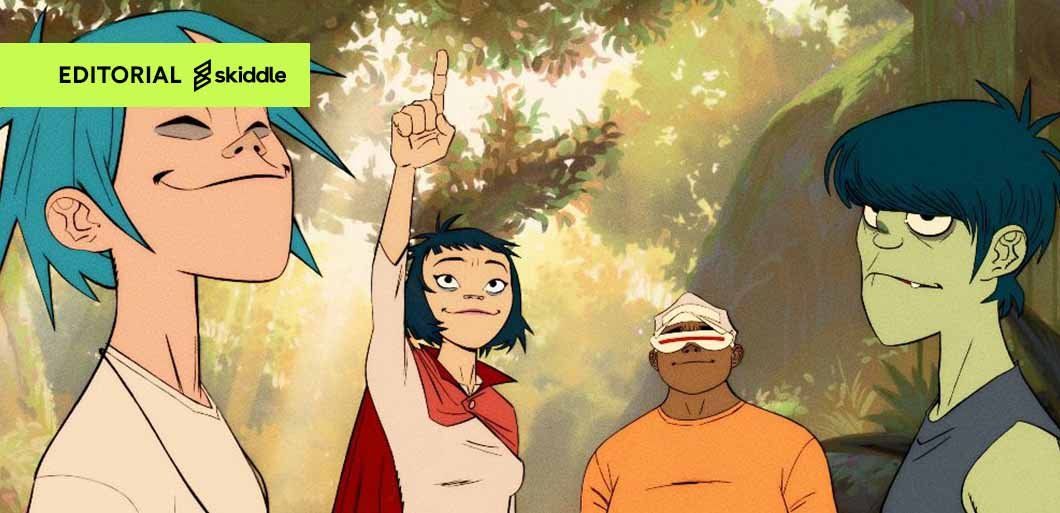
The next thing, without contest, has to be the instantly recognisable characters that make up the band: 2D, Murdoc Niccals, Noodle, and Russel Hobbs.
For over two decades, these cartoons-turned-global icons have leapt off screens and, at times, even onto stages. Whether you’ve encountered them in otherworldly music videos, stepped into their arcade-inspired digital experiences, or watched them appear through ambitious live visuals, it’s hard to imagine anyone missing these avatars, now as embedded in pop culture as the songs they perform.
The characters may take centre stage, but it’s Jamie Hewlett who gave them shape and soul. If Damon Albarn composed the sound of Gorillaz, Hewlett composed its image, determining not just how the music would be seen but how it would be interpreted.
Born in the unassuming town of Horsham, Sussex, in 1968, Hewlett showed creative instincts from an early age. As a boy, he entered a national road safety poster competition and finished second, a formative moment that nudged him toward a life in art. He later studied at Northbrook College in Worthing, where he began honing his craft in comic illustration, the medium that would shape his career.
While at college in the late 1980s, Hewlett teamed up with fellow students Alan C. Martin and Philip Bond to produce the now-legendary homemade comic fanzine, Atomtan. Created between lectures and swigging pints at his local student bar, the strip carried the scrappy, anti-establishment energy of the era. Packed with satire and exaggerated characters, it hinted at the bold linework and irreverent tone that would define some of his later, more popular works.
Amid Atomtan’s chaos emerged a character who would take on a life all of her own. Tank Girl, aka Fonzie Rebecca Buckler, first appeared in Deadline Magazine in 1988. She was an outlaw badass who drove a tank across a dystopian Australia, accompanied by her mutant kangaroo boyfriend, Mooga. Loud, anarchic, and unapologetically rebellious, Tank Girl cut through the comic landscape with punk energy and feminist undertones. Later picked up by publishing giant Penguin, her cult success cemented Hewlett’s reputation within Britain’s alternative art scene, whilst also creating a visual foundation for Gorillaz.
Hewlett’s ties to music weren’t accidental. He designed record sleeves for bands including Cud and Senseless Things, and even produced a bespoke comic strip tied to Pulp’s ‘Common People’ single for Island Records France. Long before Gorillaz existed, he understood that artwork could frame how a record was received, and how visuals could amplify its mood and context.
He first crossed paths with Damon Albarn in 1990 after Blur’s Graham Coxon, an ardent fan of Hewlett’s work, arranged for him to interview the band for Deadline. The meeting, famously, didn’t go smoothly: Blur’s bassist, Alex James, reportedly turned up drunk, vomited, and then disappeared mid-interview, while Hewlett later described Albarn as being a “wanker” throughout the ordeal. Despite the chaos and sharp words exchanged, years later Hewlett and Albarn became close friends and eventually flatmates above a carpet shop in Notting Hill. Bonded by heartbreak, gadgets, and a shared love for the sounds of the late-90s music scene, the idea of Gorillaz began to take shape.
Glued to a plasma TV Albarn had bought for the flat, they watched bland, manufactured pop acts dance across the screen on channels like MTV. In response, they conceptualised their own alternative group: an animated band comprised of distinct characters, each designed with their own identity and attitude. Hewlett imagined animations that would act, perform, and even “interview” as living beings, creating a separate digital universe while providing him and Albarn some degree of anonymity, which, as we now know, wouldn’t last long.
These characters became more than just illustrations on a page. Hewlett and Albarn had created one of the world’s first virtual bands, long before the current era of generative AI. In doing so, they rewired the traditional band hierarchy. The group’s image wasn’t a precursor to the music. It was foundational to the story of Gorillaz and the first step in the creation of the rich and evolving world of lore that we all now know and love.
When Gorillaz released their self-titled debut in March 2001, the world met 2D, Murdoc, Noodle, and Russel for the first time. The artwork was raw and kinetic, and deliberately unpolished in contrast to the glossy pop landscape of the time. The green-tinted “geep” on the cover, with the band’s name spray-painted in the corner, became instantly iconic. Hewlett’s character designs weren’t just aesthetic choices; they hinted at the musical DNA of the band itself. 2D embodied melancholic Britpop vulnerability, Murdoc channelled sleazy rock excess, his image supposedly inspired by The Rolling Stones guitarist, Keith Richards, while Russel nodded to hip-hop lineage, and Noodle fused futurism with cult cool. Before listening to the album, the band's visual coding signalled to fans that the record would be without boundaries or borders.
As the music evolved, so did the art. Each new album introduced a new “phase,” visually distinct and narratively layered. With Demon Days in 2005, the music darkened, reflecting the catastrophic events happening across the world around the time of its release, such as the war in Iraq and the London bombings. Hewlett’s characters mirrored this shift, appearing wearier and shaped by the record’s mood - a rare example of cartoons ageing in real time.
Hewlett’s ambition extended beyond covers. Holographic live appearances stunned audiences, though their complexity made them unsustainable. Instead, Gorillaz became a hybrid experience: live musicians performing alongside ever-present animated identities. Elsewhere, he commissioned limited prints, figurines, interactive websites, and exhibitions to further expand the Gorillaz universe. Underscoring Hewlett’s influence across music and illustration, he also worked on projects like The Gorillaz Art Book, which featured reinterpretations of the group’s characters by the likes of Robert Smith, Jack Black, and Erik Fountain, the creator of Adventure Time.
Across Plastic Beach, Humanz, and The Now Now, Hewlett continued experimenting with 3D forms, hand-drawn textures, and immersive storytelling. These experiments reached a new stage with the group’s latest release, The Mountain.
The album joins the virtual quartet on a new journey, leaving stardom behind to traverse the Indian wilderness in search of a mystical mountain that would provide meaning in an increasingly chaotic world. Hewlett’s artwork for the record marks another evolution. Departing from gritty textures used for previous projects, the visuals favour softer, hand-drawn illustrations over CGI, reflecting the album’s introspective tone and spiritual themes. Imagine the band inhabiting a world somewhere between The Jungle Book and a dreamlike travelogue, and you’re close.
It’s a shift that feels deliberate. As the music turns inward, so does the artwork. Where earlier phases leaned into digital spectacle, The Mountain retreats into something tactile and human, proving Hewlett’s art is not just for decorative purposes.
As with previous albums, Hewlett’s storytelling extends far beyond the cover. An eight-minute animation accompanies the album, navigating mythology, life, death, and grief - particularly poignant given that both Hewlett and Albarn lost their fathers around the time the record was being produced.
From designing road safety posters as a child to creating one of the most recognisable animated bands in modern music, Hewlett has shown that visuals aren’t an accessory to sound - they’re a narrative force in their own right. Would Gorillaz feel incomplete without his illustrations? Undoubtedly. These characters and the worlds they inhabit don’t simply accompany the music; they expand it.
Follow us on Instagram, TikTok, Threads, Facebook, and YouTube for the latest music and events content.


Header image credit: Gorillaz
Read more news



Articles you may be interested in



related artists


Gigs ● Clubs ● Festivals ● Things to do
“On your side since 2001, because we believe true fans deserve a fairer and smarter way to discover events they love.”
Why use Skiddle?
- Rated 5 stars on reviews.co.uk
- Over 17 million tickets sold
- Over 4.3 million happy customers
- Skiddle Supports - Together, we are More Than A Ticket
- Official Primary Ticket outlet
- Established 2001
- Support the Fanfair Alliance
- Sustainability - Make a positive impact
© 2001 - 2026 Skiddle Ltd | Skiddle is a registered trademark | ALL RIGHTS RESERVED