


Sound and Vision: Acid house, rave & the adoption of the smiley
How a simple club flyer, a 303 squelch and a youth movement transformed the smiley into one of music culture’s most enduring visual symbols - and why it’s still everywhere.
Skiddle Staff
Last updated: 10th Dec 2025
The green spaces of the UK, once sites of bustling festivals that entertained thousands of music fans, have long since become silent and grey. The days are drawing shorter and the weather is on the turn. It’s that hallowed time of year when our world-envied clubbing scene awakens from its slumber, revving back into full momentum, welcoming the masses back to the dancefloors.
Using this periodic time of year as a launchpad, when dancers ritualistically move from the outdoors to the shelter of some of Europe’s best dance institutions, we present to you a brand new feature on Skiddle: Sound and Vision.
Through Sound and Vision, we’ll take a deep dive into the creative crossovers between audio and visual media, spotlighting the designers, filmmakers, artists, and movements that have shaped and continue to shape music culture beyond the stage. We’ll explore how sound becomes a canvas for visual expression and how these artistic connections lend music its cultural identity and distinctive visual language.
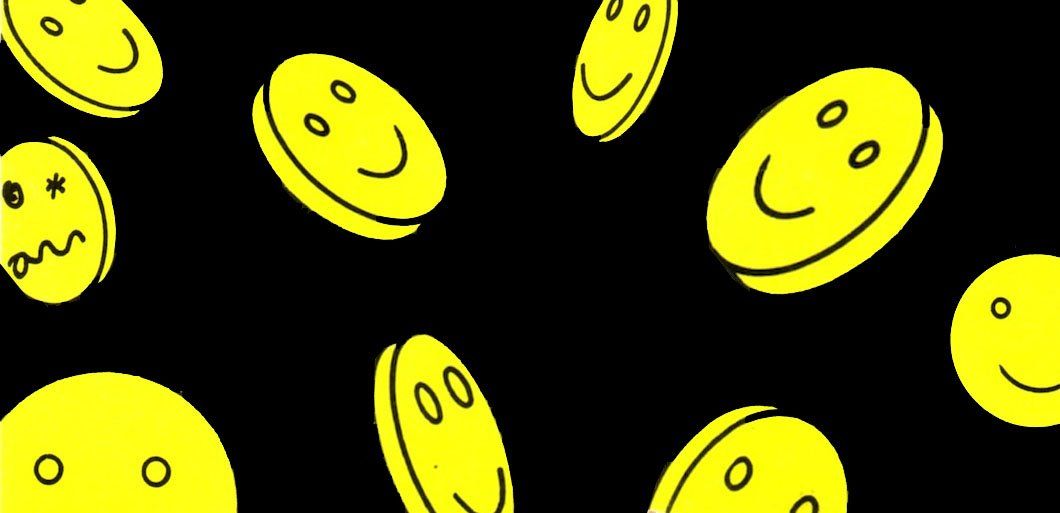
Kicking things off, we’re starting with one of music’s most iconic marriages of sound and symbol. A visual emblem of the euphoria and togetherness that defined the acid house and rave era of the late ’80s and ’90s - and one that still holds its place in club culture today: the smiley.
The story goes that this simple, yet now globally adored, symbol first found its way into the UK’s underground dance scene thanks to a then up-and-coming, London-based selector - a name most readers will be familiar with today - Danny Rampling. Part of a tight-knit group of DJs who’d recently discovered the energy and freedom of the new acid house sound, Rampling shared his early ambitions to run his own club night with fellow kindred spirits Paul Oakenfold, Nicky Holloway, and Johnny Walker - also relative unknowns at the time, but each destined to leave their mark on the electronic scene.
On a trip to the mecca of dance music, Ibiza, back in 1987, to celebrate Oakenfold’s birthday, the quartet, sometimes referred to as the “Ibiza Four”, found themselves in the thick of what was then one of the island's most famous open-air dance destinations - Amnesia. Loved up, under the spell of the era’s euphoric fuel, and of the DJ performing that night, Balearic beat pioneer and former Amnesia owner DJ Alfredo, Rampling shared with the collective his concept for what would become one of London’s most iconic parties - Shoom.
Returning to earth from a higher state of consciousness, upon touching down back in the UK, Rampling, with the backing of the Ibiza Four and his then-wife, Jenni Rampling, began piecing together the moving parts of the club night. It was during this period of planning that he happened upon a chance encounter at the long-lost Wag Club. There, he met fashion designer Barnzley Armitage, standing out among the crowd; his t-shirt emblazoned with a smiley face. It was a lightbulb moment for Rampling, who saw in that symbol a perfect reflection of the acid house movement’s energy and of Shoom’s core values: positivity, togetherness, unity, and escapism. From that night on, the smiley became the club’s official insignia - a symbol that captured the optimism at the heart of a new musical revolution, that would also, in time, come to mirror the expressions on the sweat-soaked faces of those lucky enough to experience all that Shoom had to offer.
Fast forward to the launch night. On Saturday, the 5th of December 1987, Shoom welcomed its first patrons. Held in the basement of a then-gymnasium in Southwark, the venue held no more than 300 guests, each carefully selected to enter by Jenni, working the doors. The music inside, a squelchy, hypnotic blend of emerging electronic sounds - from Detroit techno, Chicago house, and Balearic beat - mixed with contemporary pop and post-punk styles.
To get word of his new event out among London’s growing dance community and get bodies through the door of future gatherings, Rampling was going to need help. Aside from performers and the staff necessary to run such an event, he would need a striking design to accurately convey the essence of Shoom when promoting the club night to its target audience. So, he commissioned upcoming designer George Georgiou to fashion an event flyer that revolved solely around its signature symbol.
“He and Jenni called me out of the blue in late ’87 and asked if I could design a flyer for them”, Georgiou remembers. “They visited me at the design studio, where I was working in Islington, told me about the first event they had put on, which was very successful, and asked if I could produce a flyer and some banners for their next event. They probably came to me because I was the only person they knew who did flyers! But I never asked.”
“I clearly remember asking if there was anything he specifically wanted to see on the flyer; his reply was ‘a smiley face’. Otherwise, I had complete design freedom to do whatever I wanted. I definitely remember being disappointed - I hated that symbol. But they were both adamant that that’s what they wanted. I suppose it is appropriate that the smiley came to represent the ‘loved up’ attitude of acid house.”
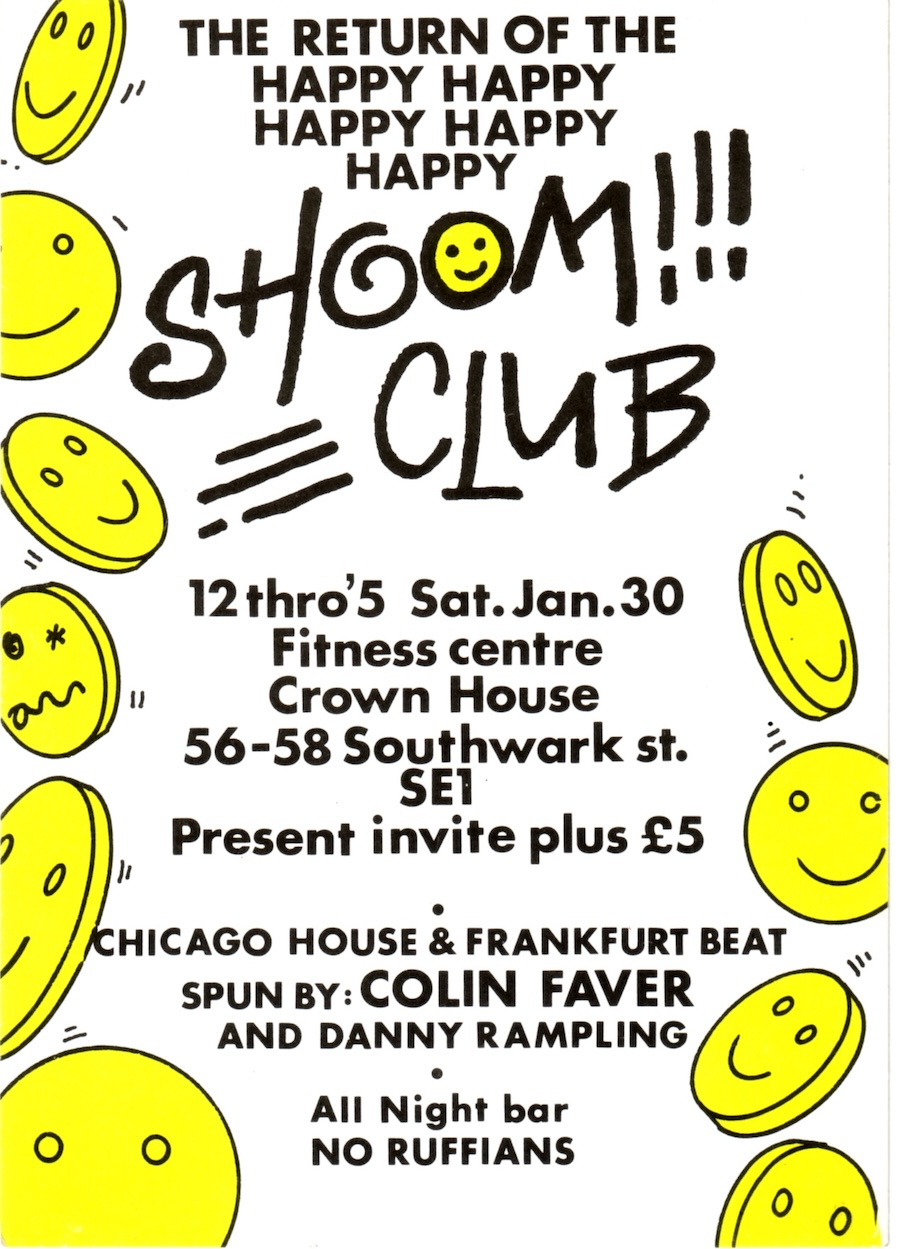
Georgiou was an up-and-coming interior designer, collaborating with a number of leading London agencies, with only limited experience in graphic work. Outside his nine-to-five, when he wasn’t out clubbing or attending Shoom nights himself, he channelled that same creative energy into reimagining club spaces and producing the visual paraphernalia that promoted some of the era’s most celebrated events and venues - among them RAW, Nicky Holloway’s Special Branch, and his later venture, the Milk Bar - all now ghosts of a lost chapter in London’s nightlife history.
“I had been 'clubbing’, as it came to be known, for a few years before the Acid House thing kicked off big time in '88. As far as I was concerned, Shoom was just another club event. It wasn’t unusual to attend parties in strange venues, so going to this one in a basement gym wasn’t out of the ordinary.”
“I remember Rampling calling me and asking if I could get him on the guest list at RAW, where I was also involved in helping with designing creative elements. Ironic, really, considering what was around the corner for him.
“He and Jenni actually ended up moving Shoom to the RAW venue at the YMCA for a while, once it had outgrown the gym.”
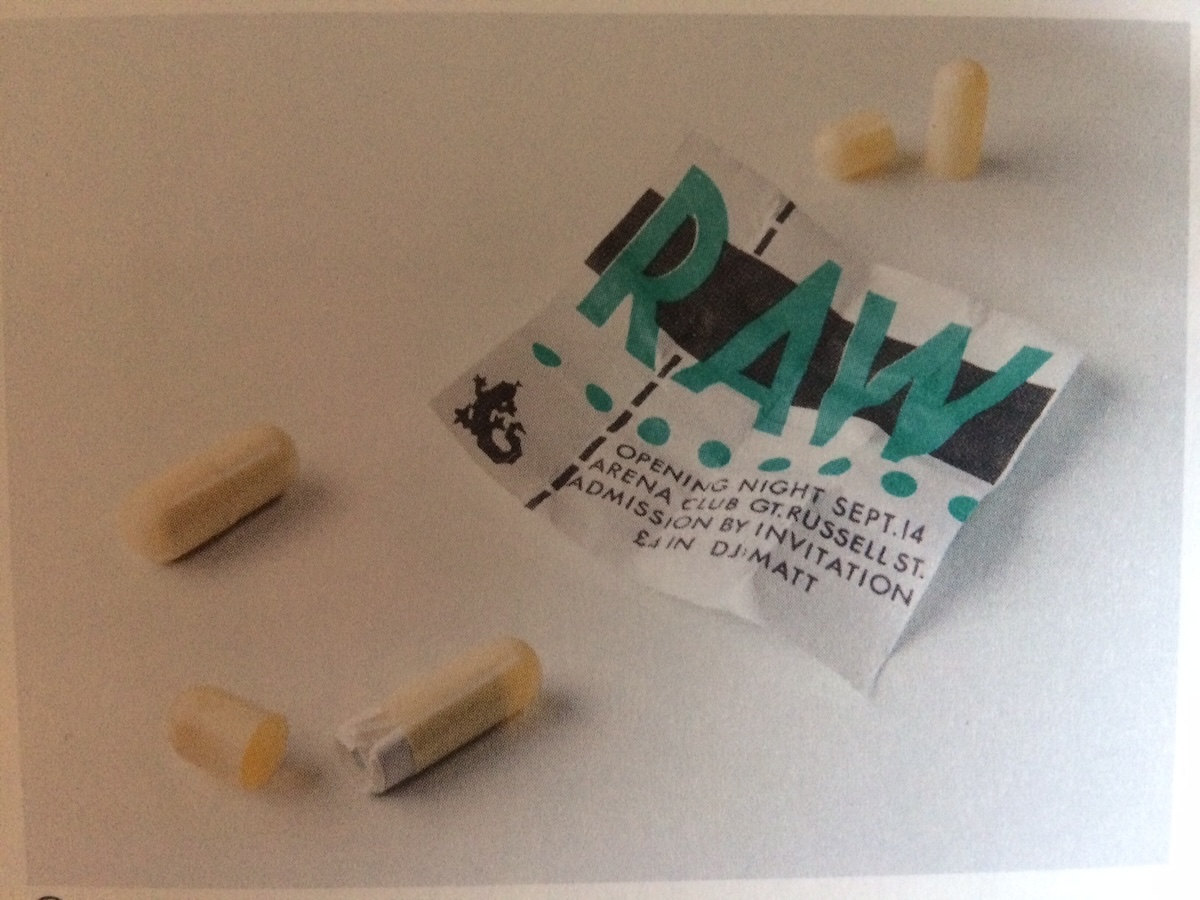
Georgiou’s flyer artwork for the third instalment of Shoom was the first to feature the now ubiquitous smiley, though he’s keen to make clear that he has never claimed to have designed the original smiley face. “On those very rare occasions when I agree to an interview, there’s always some troll waiting to berate me for taking credit for designing it (the smiley). It wasn’t even my idea to use it on the flyer!”.
Each smiley face on Georgiou’s design took on the form of an ecstasy pill seemingly falling from the sky; a design that resonated with a youthful audience just beginning to experiment with MDMA.
“I remember not having a clue as to how I would use it. I just knew that I didn’t want to stick a straightforward smiley on the flyer and be done. I had set all the copy and come up with the Shoom logo, and then I just sat there staring at it, trying to work out how to introduce it.
“Then, an idea flashed into my mind. I had been a fan of what was, at the time, a relatively new medium - computer-generated 3D graphics. I had the idea of drawing the smileys in 3D, having them tumble down each side of the flyer - just like the CG graphics I’d seen in pop music videos on TV. The fact that they looked like pills was a bonus, and naturally, everyone thought it was a drug reference, which I didn’t dispute. I guess it captured the zeitgeist.”
Later dubbed the best club flyer of all time by DJ Magazine, the design, unknown to Georgiou, would provide the initial spark for the explosion of the smiley in mainstream popular culture.
Within a couple of years of the opening night of Shoom, the UK was in the grip of the Second Summer of Love, as acid house evolved into a nationwide cultural phenomenon. A bleak economic decade under Thatcher’s rule was coming to an end. Illegal raves were taking over fields and disused warehouses, drawing people of all ages and tribes - from students to those with respectable professions and even rival football hooligan factions - to rejoice and express themselves freely under the musical guidance of acid house favourites of the era. Favourites such as Carl Cox, Pete Heller, Nancy Noise, and Mr C. At the same time, the smiley was continuing its own journey toward pop culture dominance.
Georgiou’s design was quickly adopted and reworked for the wave of events that followed Rampling’s pioneering club night. As promoters created their own variations of the smiley and spread them on flyers to draw ravers to their own parties, more commercially minded operators saw the symbol’s explosive rise and the momentum of acid house as a fresh opportunity for profit. Among them, a regular at Shoom and other early acid house nights, Tony Colston-Hayter or “Cost-inflator”, as he was known by most within the scene.
Something of a Marmite character, Colston-Hayter was the first to realise the capital potential of these high-attendance and usually low-admission fee acid house raves. Following his first foray into party planning, with his Apocalypse Now party in 1988, he moved quickly to establish his own event brand - Sunrise.
Sunrise, under Tony Colston-Hayter, emerged as a major commercial promoter of acid house events. Tickets to one of the six verified Sunrise parties that happened between 1988 and 1990 skyrocketed in price, as Colston-Hayter cashed in on the interest of fans - hence his nickname - writing the playbook for the event brands of the mega-rave era that would define the early ’90s, the likes of Helter Skelter. Thousands of people attended his events and, as the movement boomed, Colston-Hayter became the unofficial spokesperson for Acid House, taking on interviews across TV and radio, dubbed ‘Acid’s Mr Big’ by the press.
While the smiley, in its truest form, was missing from the designs used to promote Sunrise parties, what Colston-Hayter had cunningly devised was a logo that featured a wide-eyed sun with a grin across its face - essentially a smiley by another name. It was using this design that he drove revenue through sales of t-shirts, membership cards, and other branded goods.
Those membership cards would prove crucial in 1989, when the feds moved in on Sunrise’s A Midsummer Night’s Dream party at White Waltham Airfield. Colston-Hayter avoided imprisonment by exploiting a legal loophole, arguing that, because everyone held a Sunrise membership card, the event was a private party for members only. Alas, he would years later find himself in hot water with the law again, this time receiving a prison sentence of 5 and a half years in 2014 for leading a cyber gang in scamming banks out of £1.3 million.
Colston-Hayter wasn’t the only one to cash in on the back of the smiley, however. By 1989, it was everywhere: splashed across bucket hats, T-shirts, badges and stickers - a bright, innocent grin carrying a subtle undertone of anarchy. Even The Smiley Company, founded by French journalist Franklin Loufrani in 1971, enjoyed a renewed surge of attention. Holding global trademark rights to its own version of the symbol, the version used widely today, Loufrani’s enterprise emerged independently of Harvey Ross Ball’s 1963 design, which pre-dated it by nearly a decade. It’s said that Ball’s original 1963 creation for the State Mutual Life Assurance Company in the US took just 10 minutes to draw up, earning the designer the measly sum of just $45. And while the acid house crowd had little to no interest in licensing or ownership, their unfiltered embrace of the icon sent its profile and its commercial appeal stratospheric.
Eager not to miss out, even tabloid heavyweight The Sun jumped aboard as the acid house craze swept Britain, selling its own smiley-branded merchandise through the pages of its red top. Until the movement imploded.
As the decade came to a close, the public perception of acid house shifted dramatically from one of love and inclusivity to one of recklessness and depravity. Isolated instances of deaths caused by the use of ecstasy at acid house parties were being weaponised by media platforms and publications. This included the likes of The Sun, which flipped its stance from supporter to sensationalising machine, conjuring attention-grabbing headlines to increase sales of their paper. What followed was moral panic, leading to a subsequent clampdown by the Police on illegal raves and parties, spelling the beginning of the end of one of the last great youth movements of the 20th century.
By the mid-'90s, acid house was all but finished. But the smiley still lived on. As the authorities tightened their grip, a new sound and a new kind of smile began to take shape across the Atlantic.
Grunge landed on UK shores and the smiley took on an entirely new look, as Kurt Cobain’s Nirvana repurposed its once happy demeanour to reflect the mood of a new generation disillusioned by mainstream culture and over-commercialisation. It even managed to infiltrate the big screen, appearing on Tom Hanks' mud-splattered t-shirt in 1994’s multiple award-winning epic, Forrest Gump. But it would take another twenty years for the smiley to make its resurgence once more in dance music circles.
The national treasure that is Norman Cook, AKA Fatboy Slim, can be thanked for helping the smiley to make its comeback in 2015. A widely reported fan of the acid house movement and avid collector of smiley memorabilia, Cook is said to be obsessed with the icon. The now 62-year-old DJ legend even has a tattoo of a smiley on his arm. So it makes perfect sense that he would choose to make the symbol the official figurehead of his Smile High Club event brand. It’s said that, at some Smile High Club events, he actually went as far as to turn attendees into walking smiley faces, encouraging clubbers to visit the “acid converter” to have their body sprayed yellow. Gangster trippin’.
The following year saw the smiley cropping up again. This time, in London nightclub Fabric’s #savefabric campaign, in which the design was incorporated into Fabric’s logo to signify resistance to the closing of the venue, after losing its licence in 2016. The campaign was ultimately successful, rallying the electronic music community to help raise more than £200,000, enabling the venue to continue operating under new conditions agreed with Islington council.
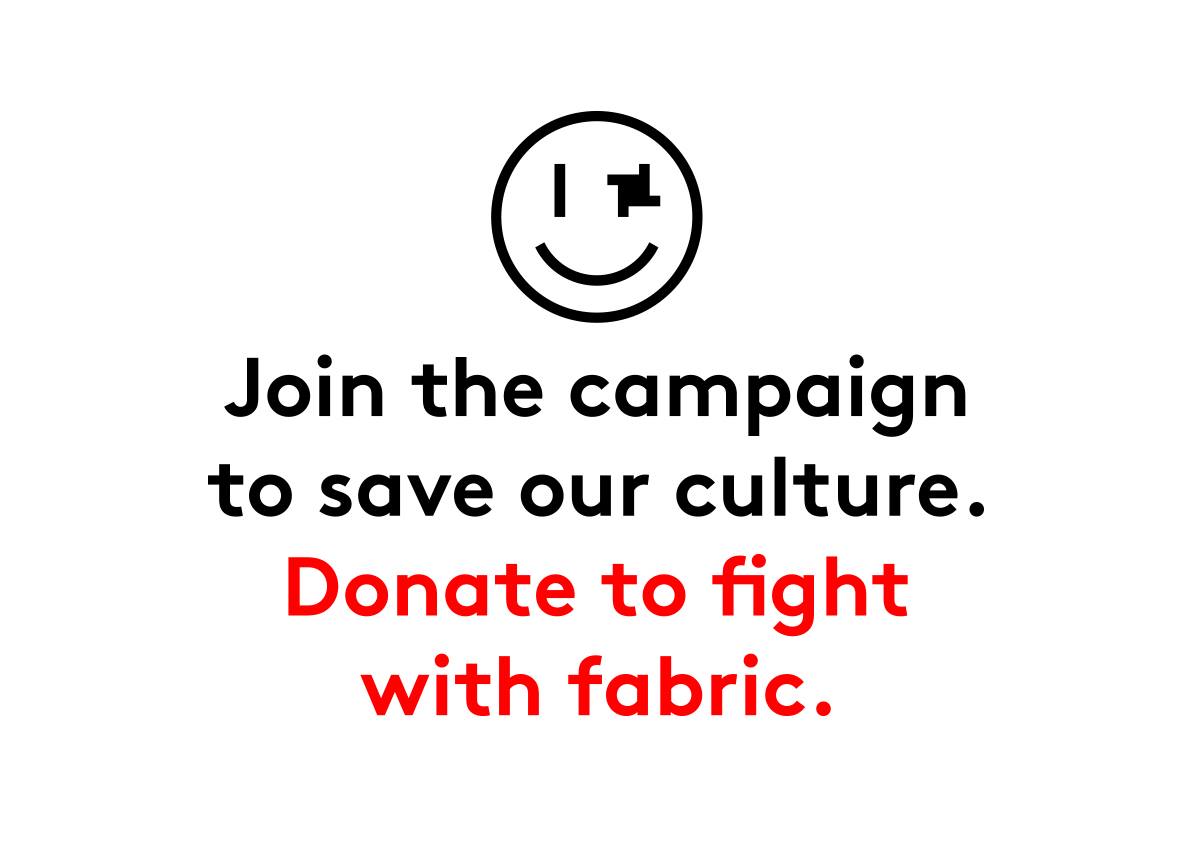
(Image credit: Save Our Nightlife/Facebook.com)
One thing’s for certain, as we move through the final weeks of 2025 and into 2026, we’ve not yet seen the end of the subgenre’s enduring totem. Contemporary names within the scene, such as Ewan McVicar, along with the teams behind long-standing event brands like Liverpool’s Save the Rave and Scotland’s STREETrave (originally founded in the late 80s), continue to proudly use acid house’s defining motif to promote their shows. A variation of the smiley has even appeared on Behringer’s gear - most notably its TD-3 Bass Synth.
Part of the wider wave of nostalgia shaping modern culture in recent years, the smiley is also set to keep appearing well beyond the community where it first made its mark. The Smiley Company, for instance, will soon refresh its trademarked design in collaboration with (RED) - the organisation founded by U2’s Bono and activist Bobby Shriver - creating limited-edition capsules to help raise funds in the fight against global health injustices.
Decades after it first lit up the dancefloor, the smiley still grins, proof that the spirit of acid house never really fades; it just changes faces now and again. And as it prepares for yet another rebirth, refreshed for the year to come, and generations removed from Shoom’s sweat-slick walls, it remains what it always was - a universal symbol of joy and unity, and a perfect reminder of how powerful visual culture can be in shaping the sound of a generation.
Follow us on Instagram, TikTok, Threads, Facebook, and YouTube for the latest music and events content.


Header image credit: George Georgiou/Shoom (Facebook.com)
Read more news


Articles you may be interested in
related artists


Gigs ● Clubs ● Festivals ● Things to do
“On your side since 2001, because we believe true fans deserve a fairer and smarter way to discover events they love.”
Why use Skiddle?
- Rated 5 stars on reviews.co.uk
- Over 17 million tickets sold
- Over 4.3 million happy customers
- Skiddle Supports - Together, we are More Than A Ticket
- Official Primary Ticket outlet
- Established 2001
- Support the Fanfair Alliance
- Sustainability - Make a positive impact
© 2001 - 2026 Skiddle Ltd | Skiddle is a registered trademark | ALL RIGHTS RESERVED