
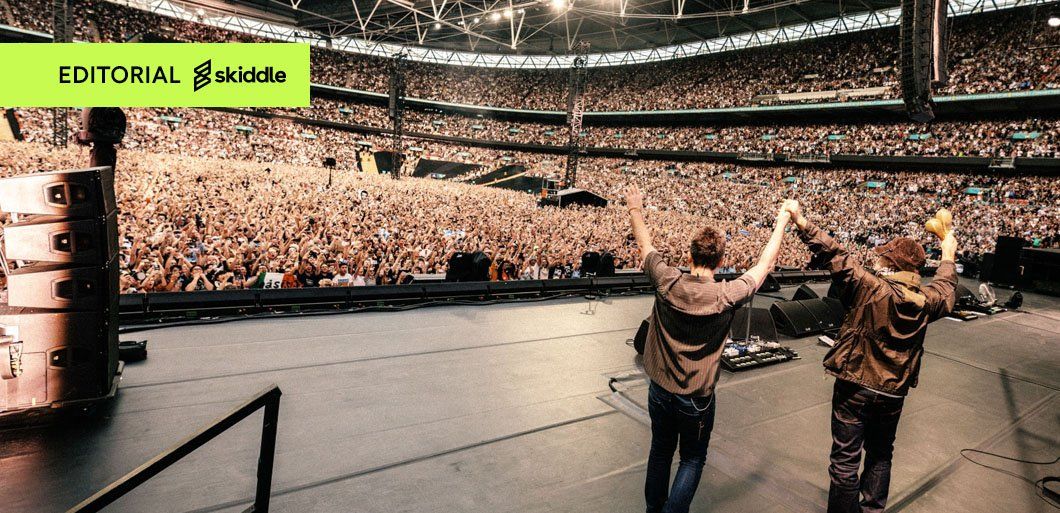
Beyond nostalgia: what the return of Oasis and Britpop tells us about 2025
Britpop’s defining act is back, along with a revival of ’90s culture. Discover how it taps into our shared longing for connection and the comfort of simpler, more certain times.
Skiddle Staff
Last updated: 6th Oct 2025
Arriving as a natural successor to 2024’s Brat Summer, swapping edgy, noughties-inspired club-pop for an unmistakable soundtrack of iconic Manc anthems, Britpop Summer landed in full force this year. But it brought with it more than just a revival of a much-loved sound. It’s a full-blown aesthetic, attitudinal and cultural reset, drawing directly from the swagger of the mid-90s.
Nostalgia, as previously covered on Skiddle, has evolved from a subtle yet constant, bubbling undercurrent in years gone by to an influential power in 2025, largely due to the announcement of the long-rumoured reunion of Oasis and the Gallagher brothers - now a sold-out reality. It’s not just a musical moment, though. Fashion retailers are leaning in with Oasis-branded gear, and Gen Z are styling themselves with a distinct nod to the past. We’ve seen skits on TV, and almost every social media platform has been flooded with content specific to the reforming of the group since the news broke, such is their cultural importance.
But why exactly is the Britpop sound being welcomed so openly again, by younger and older audiences alike?
The new face of nostalgia
A quick 360 of today’s hellish landscape is enough to explain it. From the dire state of foreign affairs to the polarised mess of domestic politics, the exponential - and frankly terrifying - rise of artificial intelligence, and the ever-escalating climate crisis, there’s no shortage of awful sh*t pushing us to get all wistful about the past.
Consciously or not, we’re craving something deeper than what any band, brand, or algorithm can sell us. We want normalcy. Simpler times. Moments we either lived through ourselves or borrowed from someone else’s memories. And for many, the Britpop era embodies exactly that.
The early 90s brought a strange sense of stability and optimism. The Cold War had ended, and economic conditions were improving in the wake of Thatcher’s departure from government. Youth culture was thriving and new movements were appearing, experimenting and pushing the boundaries of what was possible in TV, film, fashion and, most importantly, music. People were carefree and optimistic about what the future held, excited by technology while still unconcerned that a machine simulating a human might one day take their job. It was a time when connection happened in the real world - in pubs, at gigs and within local communities - and not through memes. A less dystopian chapter when we weren’t glued to screens, doomscrolling through daily catastrophes and injustices, interspersed with short videos of people dancing or lip syncing to the latest pop chart banger. When loneliness wasn’t considered an epidemic.

Image credit: Oasis / Facebook.com
Ask any Gen Xer or millennial and you’ll hear the same thing: those years felt less complicated, more joyful, and packed with possibility. And through it all, Oasis were there, soundtracking the highs, heartbreaks, and hangovers
For some, Oasis is a time machine: summers of first loves, late-night buses, and cheap nights out with mates. For others, the band shaped identity and built lasting friendships based on shared interests. For Gen Z, however, Oasis offers something different: escape. A break away from online culture, from the hyper-disciplined modern lifestyles and constant violence found on social media. A way to reach back to a time romanticised for its authenticity, its rawness, and its sense of togetherness.
And the science backs it all up. Psychologists Dr. Constantine Sedikides and Dr. Tim Wildschut from the University of Southampton have spent years studying nostalgia. Their research shows it “is often stirred in times of transition or uncertainty, serving as a refuge that helps individuals maintain continuity and meaning in their lives.”
The dominating thread here is connection. A longing for shared moments, for being part of something bigger. Yes, Wonderwall might be overplayed, but get a room full of strangers belting it out together, lyrics slightly skewed, arms around shoulders, and something just clicks. It’s communal therapy, the sort we once depended on every weekend at the local, before streaming platforms and takeaway apps rewired us. Ironically, we’ve never been more digitally connected, and yet never felt further apart.
If Brat Summer was about rebellion and finding your own “bad girl” identity, then Britpop Summer feels vastly different. It’s heavier. More existential. Less about choosing who to be and more about belonging again. Nostalgia is the hook, but beneath it all, the deeper pull is the desire to reconnect.
The economy of revival
Anyone still caught up in the moment - all dewey-eyed because Liam and Noel finally kissed and made up - believing peace was brokered to bring Oasis back for the people, might be seen as somewhat naive. Money talks, as they say.
For the cynics, this reunion was inevitable. Some argue the feud ended years ago, with the brothers keeping the beef alive just long enough to build hype for their “shock” comeback. Regardless of which side of the fence you’re on - romantic or realist - one thing’s undeniable: the financial impact of the band’s return is enormous.
Aside from ticket sales, brands have piled in on the opportunity, desperate to cash in on the Oasis effect. Adidas has gone as far as opening dedicated Oasis stores in Manchester and London, stocking official merch throughout the 2025 tour, and likely well beyond. (Legend has it your da’s still queuing to get in.) Levi’s has tapped into the nostalgia, too, releasing a line of “era-authentic” tees and jackets, while Lidl entered the chat with a knock-off of Liam’s iconic Berghaus Trango jacket. Burberry, meanwhile, isn’t officially linked to the tour but cleverly jumped on the bandwagon with a campaign starring Liam and his children. Between Adidas and Burberry alone, merch-driven sales have already soared past £118 million.
And it isn’t just about new merch. Fans are leaning hard into the original Oasis aesthetic: bucket hats, zip-up track jackets, mod parkas, football shirts, Adidas Gazelles, baggy jeans, and vintage sportswear. While these staples never truly left the style radar, interest has exploded since the tour announcement. Depop reported a 30% year-on-year spike in searches for Adidas tracksuits and a 61% surge in bucket hat demand.
Have you got your ‘Lidl By Lidl’ Oasis inspired jacket yet? https://t.co/FyCWUGDHME
— Rolling Stone UK (@RollingStoneUK) July 4, 2025
But the economics of this eyebrow-heavy Mancunian reunion go far beyond the turnstiles and merch stands. The impact on local economies is staggering.
According to Novuna, one of the UK’s leading financial providers, the tour is expected to inject a whopping £940 million into the British economy. More than half of that - £544.9 million - is expected to directly benefit local communities, fuelling retail, hospitality, transport, and tourism. On the surface, it’s a win-win. But here’s the twist: not everyone’s celebrating.
The sheer demand for tickets, accommodation, travel, and merchandise has triggered sharp price hikes across the board, contributing to an uptick in inflation. Economic commentators are already warning about its measurable impact on the Consumer Price Index (CPI), the metric that tracks changes in the average cost of goods and services, from food and fuel to housing and transport. The effect has even earned its own name: “The Oasis Bump.” And here’s the kicker: when CPI rises, disposable incomes shrink.
Still, the Oasis Bump looks to be short-lived. In the grand scheme, the reunion has been a net positive. But beyond the spreadsheets, what does all this say about fandom, identity, and the present moment?
What’s clear is that there’s big money in reviving musical legends and the culture they once defined - no surprises there. It also reinforces just how vital the music industry is to the UK economy. Look closer still, though, and the merch queues and ticket sales hint at something even deeper: an identity issue.
For older fans, it’s easy to see this as reclaiming a moment they once lived through. A chance to relive the chaos and community of the ‘90s. For younger fans, though, it’s something entirely new. Pumping hundreds, even thousands of pounds into tickets, travel, and merch isn’t just about a band - a great one at that. It’s about being part of something bigger. Something that feels harder to find today than it did back then.
So, what else is harder to come by these days that would’ve been commonplace in the ’90s? A Tamagotchi? A Woolworths - still a much-missed legend of the high street, no doubt fondly remembered by the more time-weathered readers. The pain of dial-up internet? And what about the “lads” and “ladettes” who once defined the era’s look and outlook? Are they gone for good… or are we on the verge of a comeback?
The return of “Lad” culture?
When we look back at the height of Britpop, it’s easy to picture the archetypal “lad” of the era. Loud, brash, and unapologetically confident, swaggering with the bravado of Liam Gallagher himself. They loved their casual clobber, football and terrace culture, music, nights out, and, overall, having it large. Responsibility? That was tomorrow’s problem.
Alongside them came the ladettes. Equally rebellious, equally unapologetic, and every bit as disruptive to societal expectations. They challenged traditional norms of femininity, embracing heavy nights out, sports, and the kind of unfiltered banter previously reserved for the lads. Figures like Sara Cox and Zoe Ball became emblematic of this cultural shift, where women claimed a space in a subculture once dominated by men.
Both groups were largely rooted in working-class identity. Back then, many found solace and relevance in the words and demeanour of Oasis: fellow working-class northerners whose defiant anthems became a rallying cry. It was less about politics and more about solidarity, pride, and sticking two fingers up to authority. But that was then.
So, with Oasis back on the scene, are we seeing a full-blown resurgence of lad culture? Are we once again inspired by Liam and Noel’s cocksure defiance to give the world a collective “let’s have it”? Not quite.
Yes, the crowds at Oasis’s reunion shows look strikingly familiar - the bucket hats, the vintage Adidas, and an unmistakable energy - but they’re not carbon copies of the 90s stereotype. This is lad and ladette culture 2.0: subcultures that carry the aesthetic and attitude, but filtered through a modern lens.
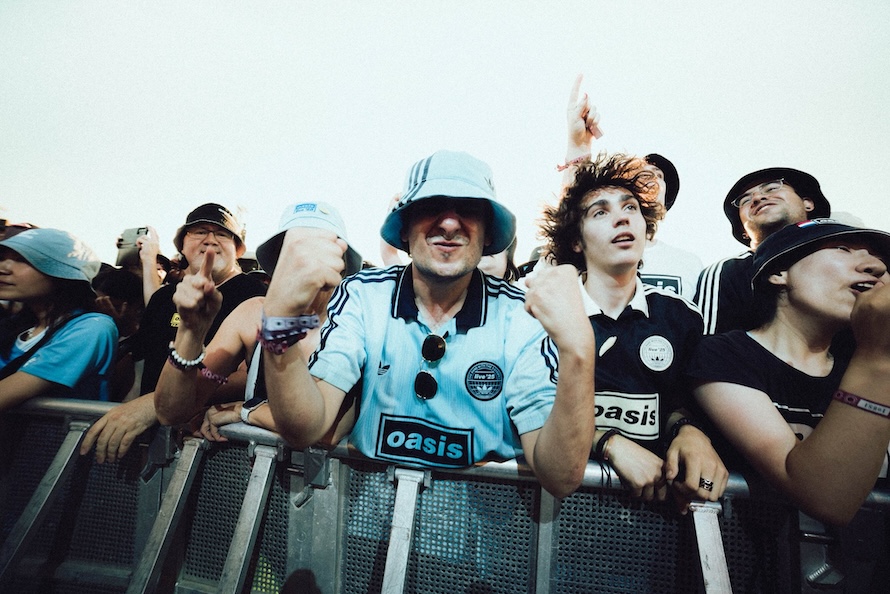
Image credit: Oasis / Facebook.com
Today’s audiences are more diverse and inclusive than the original wave ever was. Among the die-hard millennial and Gen X fans are thousands of Gen Z gig-goers - a generation discovering Oasis for the first time. Their ethics are often very different from the 90s stalwarts. More socially aware, more open-minded, and less invested in rigid gender roles, they engage with the band’s music in a way that feels fresh and less bound to the old “lads and ladettes” framework.
This mix creates a dynamic live experience. Older fans bring raw, nostalgic energy - remembering the glory days and reclaiming fragments of their youth - while younger attendees approach the moment with curiosity and a different cultural perspective. It’s an unexpected coexistence, where swagger meets sensitivity and tribalism meets inclusivity.
The style, the camaraderie, the peacocking… It’s all still present, but tempered by something new: maturity. There’s a stronger sense of emotional intelligence among the crowds, a willingness to embrace difference, and a collective understanding that we’ve entered a different cultural moment. The nostalgia effect is undeniable, but the context has shifted. The 90s are long gone, and today’s revival plays out against a backdrop of heightened social awareness and a very different zeitgeist.
Lad culture, as it once existed, isn’t coming back in full. What’s emerging instead is an evolution: one that borrows from the past but prioritises empathy, inclusivity, and the self-awareness of today.
The Influence on Music
What does the resurrection of Oasis mean for the future of the scene?
It’s an intriguing question, and one without a definitive answer. There are already plenty of acts channelling the spirit of Oasis and others from the Britpop era - think The K’s, The Sherlocks, The Royston Club, and The Reytons, to name just a few. Then there are those who are vocal about Oasis’ influence on their work, even when it’s not immediately obvious on first listen - from Manchester-born wordsmith Aitch and Welsh electronic musician Kelly Lee Owens to Jehnny Beth, the former frontwoman of Savages. But we’re yet to feel the full influence of the band’s return on the next generation of musicians and performers.
Could we be on the brink of an indie renaissance? Could a new wave of acts, blending the archetypal sound and attitude of Britpop with modern styles, once again dominate the lineups of iconic alternative festivals like Reading and Leeds? Or are we simply headed for another recycled repackaging that’s been done one too many times? But then again, hasn’t music always done this - reworking the past into something new? Would Oasis even exist without The Beatles, for example, whose influence the Gallagher brothers have always been open about?
This leads us to a bigger question: where do we draw the line between homage and pastiche? Would a resurgence of the Britpop sound be driven by genuine creativity, or would groups and musicians simply write to feed algorithms and cash in on nostalgia? Its authenticity would need to be scrutinised.
The challenge is that today’s mainstream music press often feels unequipped to ask the tougher questions. Commercial pressures in the digital age, like the need to stay neutral to protect ad revenue and brand partnerships, combined with the rise of cancel culture, have, in many ways, censored the music press. Writers are increasingly boxed in when it comes to what they can and can’t say about a track or an artist. Sure, music journalism has become more democratic and arguably more responsible, but it’s also become far more cautious. Too much of today’s coverage feels fluff-filled, homogenous, and endlessly echoing, with fewer journalists confident enough to express bold opinions for fear of backlash. Ironically, though, the return of Britpop might just shake that up.
In the 90s, music journalism was unapologetically opinionated - sharp, witty, and, at times, downright snarky. It had bite. But it wasn’t without its problems. The era produced tabloid-style coverage, cheap sensationalism, and a heap of deeply outdated beliefs, from misogyny and homophobia to the lad-banter-as-journalism approach, all of which are best left firmly in the past. Still, if Oasis’s return signals some kind of cultural rebound, it could free the press from its current state of caution. Could we see a shift back to gritty, entertaining, rock ‘n’ roll journalism? The kind that challenges and provokes, and has a personality?
Where the current state of music is concerned, over the past two decades, the pendulum has swung firmly in favour of more rhythmic and electronic styles. Commercial radio stations, festival lineups, and even TV ads have been dominated by beats and basslines, with acts like Bicep being commissioned to soundtrack promotions for major sports car brands and globally renowned soft drink manufacturers. But Oasis’s comeback could mark a turning point. It could provide a spark capable of sending the pendulum swinging back toward guitar-driven music, reshaping the UK music scene in the process. It could lead to a more organic revival, one where musicians and fans come together again to experience music in their droves - something that would almost certainly spell good news for the UK’s struggling grassroots venues.
All of this again feeds into that broader theme of connection. A revival of ‘90s and Britpop-inspired culture taps into that deep, collective yearning for shared experiences. And what better place to find it than in a sweaty crowd, dancing on sticky floors down at your favourite local music venue?
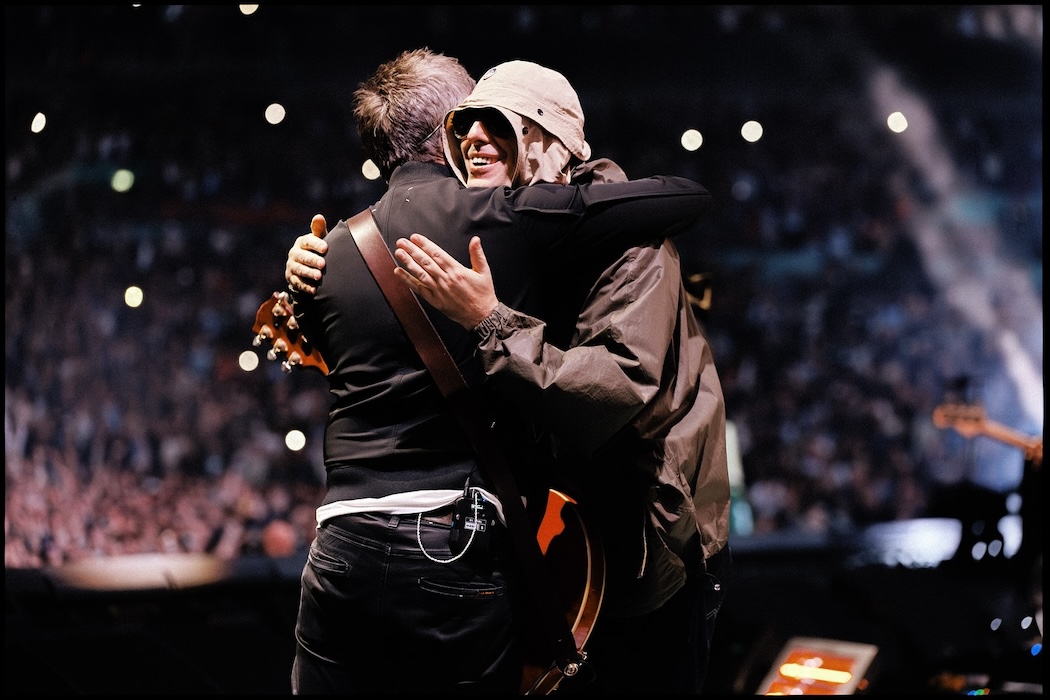
Image credit: Oasis / Facebook.com
So what does the return of Britpop and its defining act (sorry, Blur fans) really tell us about 2025? And, more importantly, what does it say about us?
If we accept that there’s more going on in our collective psyche than we fully understand, and that the return of Oasis holds some deeper cultural significance, then the answer is simple: doom fatigue is peaking.
We’re all retreating into culture, nostalgia, and togetherness. Still the same creatures of habit we’ve always been, we’ve assembled en masse, rallying around the one thing that consistently brings us closer - music. It’s a distraction technique: A coping mechanism to help us disassociate from the real world, albeit a pricey one. Whether Noel and Liam have knowingly tapped into this emotional undercurrent is up for debate (our money’s on them not having the slightest clue), but the timing of Oasis’s return is flawless and in many ways, absolutely necessary.
It also speaks to a deeper identity crisis bubbling under the surface. In the absence of strong musical or fashion subcultures, we’re flailing. The sharply defined tribes of decades past have vanished, replaced by algorithmically generated playlists and neutral, beige journalism that rarely dares to offend or inspire. Everything is curated for us. So when something as messy, bold, and unapologetically loud as Britpop resurfaces, it sparks something visceral. A reminder of a collective urge we’d nearly forgotten. But let’s be honest, this isn’t the 90s. The authenticity is up for debate. Sure, the hardcore fans are still out there, and in Oasis’s case, there are plenty. But in places, the revival feels disingenuous. Like nostalgia with a marketing budget. And a good chunk of people are here not out of belief, but out of FOMO.
That, too, is a sign of the times. A symptom of an era where trends steer our tastes, telling us what to wear, what to eat, and what to listen to. It could be that we’re looking at this the wrong way, though. Can we really call Oasis a trend? They’ve been part of Britain’s musical DNA for over three decades. Maybe what we’re seeing isn’t just a flash-in-the-pan revival. Maybe it’s the start of something bigger - a real shift in UK music and culture.
Is Britpop back for good? The jury’s still out. But one thing’s certain: we’re still searching for something to belong to. Maybe the past isn’t just comforting. Maybe it’s the only place that still feels real.
As you were.
Follow us on Instagram, TikTok, Threads, Facebook, and YouTube for the latest music and events content.


Header image credit: Oasis / Facebook.com
Read more news




Articles you may be interested in


Gigs ● Clubs ● Festivals ● Things to do
“On your side since 2001, because we believe true fans deserve a fairer and smarter way to discover events they love.”
Why use Skiddle?
- Rated 5 stars on reviews.co.uk
- Over 17 million tickets sold
- Over 4.3 million happy customers
- Skiddle Supports - Together, we are More Than A Ticket
- Official Primary Ticket outlet
- Established 2001
- Support the Fanfair Alliance
- Sustainability - Make a positive impact
© 2001 - 2026 Skiddle Ltd | Skiddle is a registered trademark | ALL RIGHTS RESERVED